
The Bankruptcy Bill seeks to ensure predictability of outcome for creditors.

'Nature doesn't bother even if the Supreme Court says it is legal!' 'If something is in the wrong place, it will be damaged or destroyed by nature.'
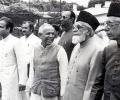
Today as one sees the Owaisi brothers of Hyderabad seeking to lay claim as the custodian of the Muslim vote and the upholders of the community's interests, it is Shahabuddin who springs to mind for having been there, done that, says Saisuresh Sivaswamy.
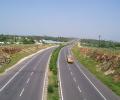
Private sector firms need to be re-engaged for better infra planning.

'You can ascribe any ideology to him, and it will be equally right - or equally wrong.' 'Even though the comrades on the Left will never admit it, he seems as much Stalinist as capitalist.'
.jpg)
Modi government must push reforms at a fast pace to restore growth.

'One wonders if he has decided on the disastrous course of taking after Manmohan Singh, sitting like a Madam Tussaud wax figure, the same expressionless face, eyes unblinkingly staring in front, and making absolutely no difference, and no contribution, to the House proceedings,' asks B S Raghavan.
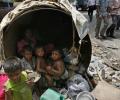
Angus Deaton's Nobel Prize should spark off more research on the measurement and usefulness of poverty percentages.

AMU has once again been pulled into a crossfire of crass political opportunism. In these post-truth times, that the university also had political stirrings not subscribing to the Muslim League is chosen to be forgotten, says Mohammad Sajjad.

Let Bihar be damned under its contradictions of having gone 'dry' and then having been submerged under flood, which is a recurrent phenomena? After all it is a godforsaken land, having lost its promises of overcoming its problems, says Mohammad Sajjad.

The prime minister's August 15 address was undoubtedly inspirational and outlined important economic and social objectives, such as making India a global hub for manufacturing, ensuring bank accounts for all poor families, major thrusts in sanitation and cleanliness, and a radical restructuring of the Planning Commission.

'Nitish is now a helpless junior ally of Hindutva.' 'He just cannot think of reining in the hoodlums raging, marauding and killing in the mohallas,' argues Mohammad Sajjad.

Governor's rule was imposed in Jammu and Kashmir on Friday after political parties failed to muster the requisite number in the 87-member assembly for staking claim to form the government.

Rediff.com presents the gist of the speech delivered by Mr. Kailash Satyarthi on the Foundation Day of Rashtriya Swayam Sewak Sangh.

RBI's out-of-turn rate cut has surprise few economists.

IMF attributes the slower growth rate to supply-side bottlenecks.
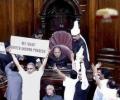
It is quite likely that the Parliament itself could now attract people's scorn. That would be terrible, and not the people but the politicians would be responsible, says Mahesh Vijapurkar.

The Congress will only be able to gain from the bill if its benefits percolate down to the people within the next eight months, says Anita Katyal

'Hindu voters in coastal Karnataka lean more towards Hindutva than Hinduism which explains why the Siddaramaiah government's perception as anti-Hindu worked wonders for the BJP in coastal Karnataka.'

'I recall an encounter I had with a US Congressman of Cuban origin, who was hostile to India because of our continuing goodwill for Cuba.' 'He asked me why India was still friendly with Cuba and I gave him an honest answer that it was rooted in historical and friendly ties.' 'He took it as an affront and spread the word that an Indian diplomat had defended Fidel Castro in his chamber!'

Rajeev Chandrasekhar discusses five issues pivotal for the success of Digital India

'Growth is predicated on the misery of large sections of people.' 'Maybe Hindutva will be used to suppress any such unrest.'

'The Senators were playing safe, not angering either the pro-India lobby or the pro-Pakistan lobby, but perhaps more importantly, the military-industrial complex -- the most powerful lobby of all -- which the majority of Senators are beholden to in terms of largesse to their campaign coffers.'
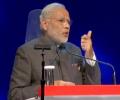
"Reform is not an end in itself. Reform for me is just a way station on the long journey to the destination. The destination is the transformation of India," he said.
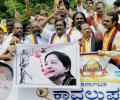
Verifiable 'distress-sharing' of available water may still be the way out of the Cauvery water row, says N Sathiya Moorthy.

Congress gets into the opposition groove but still has miles to go, says Saroj Nagi.
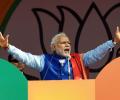
Kickstarting the Bharatiya Janata Party's poll campaign for Delhi, Prime Minister Narendra Modi on Saturday wooed voters with a host of promises as he singled out 'anarchist' Aam Aadmi Party leader Arvind Kejriwal for attack and asked voters to punish him for "wasting" one year.
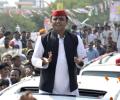
Several SP leaders fear Muslim voters may shift loyalty, which will benefit rivals like the BJP.

The blockchain, the public ledger that tracks every bitcoin transaction, is changing commerce as we know it, says Devangshu Datta.

The fragmentation of politics and the pressures of coalition management have contributed to a near-secular rise in budgetary social expenditures and spending on subsidies since 1991, leaving little fiscal space for government-led capital investment.

Jaitley said the Opposition has been using the zero hour to raise the issue for 'getting footage on TV'.

Imagine being a part of a country, but being discriminated against by the majority community and atrocities being committed against you by the state. This is the deplorable conditions that the Rohingyas of Myanmar live in where they are cut off from their livelihoods and sources of income, unable to access markets, hospitals and schools, and have little or no access to relief aid. In order to understand the situation and the genesis of the tragedy unfolding, Rediff.com's Archana Masih speaks to Ambassador Vijay Nambiar, the United Nations' Chef de Cabinet (Chief of Staff), who had served a long stint with the UN in New York on the issue.

What is Change really like in Bihar? Once seen as India's basket-case, what is its turnaround story like?

Twenty-eight years ago almost to the day, 37 unarmed Muslims were killed in cold blood, an act of wanton violence for which no one has so far been held guilty. Jyoti Punwani and photographer Uttam Ghosh visited the Meerut locality after the trial court recently acquitted the security personnel charged with the killings, and found a town untouched by its grim past.

Prime Minister Manmohan Singh on Friday disagreed with those in the Congress who were dismissive of the challenge posed by Narendra Modi but asserted that the party would approach the 2014 Lok Sabha polls with self-confidence, irrespective of the results of the just concluded elections in five states.
The corporate sector does not care from where the money is coming.
2014 will be a watershed election. Much is at stake and much needs to be changed. Women need their voice to be heard and they need representation with real power, says Sunanda Vashist.

Atal Bihari Vajpayee would seek to placate the hawks in the RSS by stating that the writing of history should not be one-sided. At the same time, he would project a moderate 'Nehruvian' image of himself as the archetypal liberal politician who would strive to attain a balance between conflicting viewpoints. A fascinating profile of the former prime minister and Bharat Ratna by Paranjoy Guha Thakurta and Shankar Raghuraman.

The year 2014 has been an eventful one for India. The country got a new government and a new state, broke new frontiers in various fields and of course its share of controversies.

What is Change really like in Bihar? Once seen as India's basket-case, what is its turnaround story like? Archana Masih reports from India's other most talked about state.
